Jesus Christ: The Great Deregulator
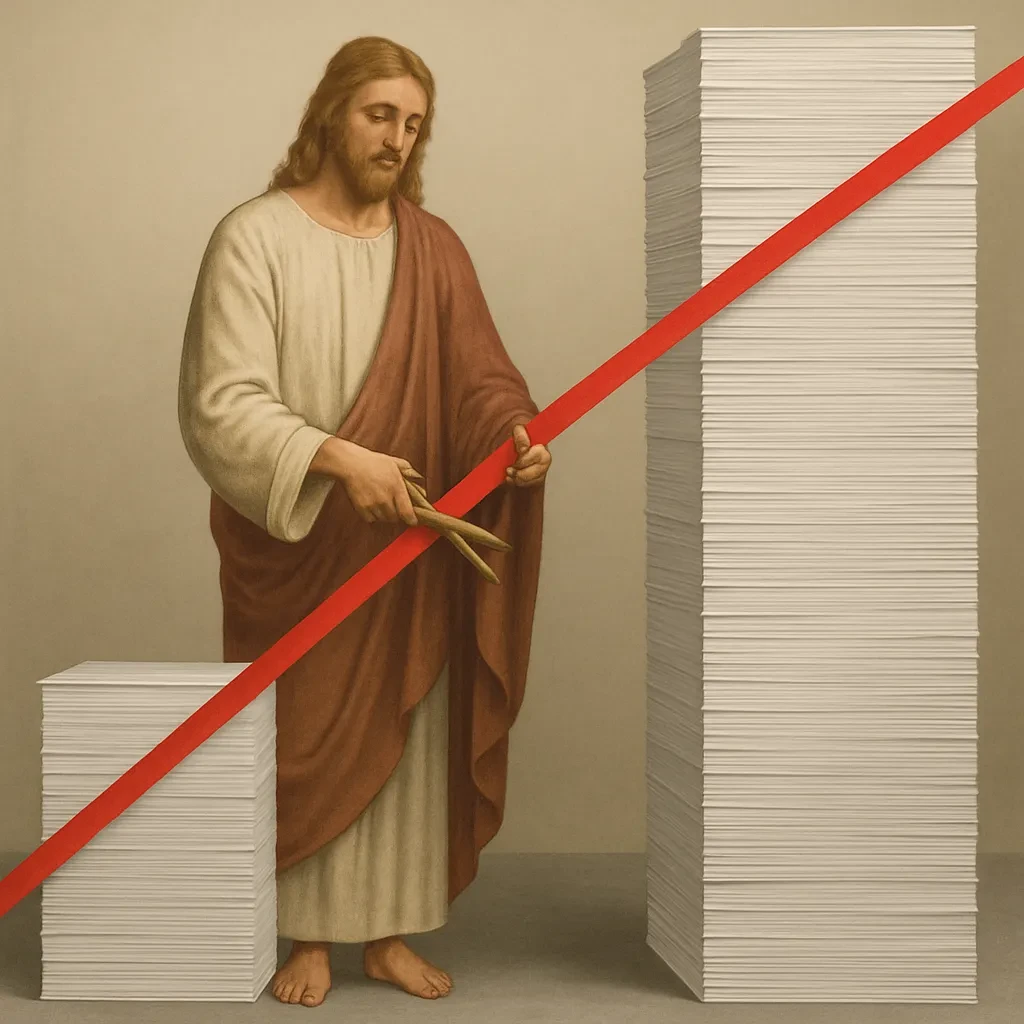
The carpenter from Nazareth overturned the entire religious regulatory system of his day. He lifted future Christians from the burdens of ritual law and challenged the authority of the religious elite who enforced it, ushering in a radical new covenant of spiritual freedom. His revolution was not just theological but a bold strike against overregulation, cutting through the red tape of religion to ensure direct access to God.
What’s often forgotten about the Ten Commandments is that they were just the beginning of a much broader and exhaustive legal code given to the Israelites. When God met Moses on Mount Sinai and etched those commandments onto stone tablets, they were not a standalone list, but rather the highlights of an intricate system of 613 laws found throughout the Torah. These laws governed nearly every aspect of life, from civil and criminal justice to dietary restrictions, clothing, rituals, hygiene, farming practices, and social relations. They specified which animals could be eaten, how and when to worship, what fabrics could be worn, how to handle disease, and even how to treat foreigners, slaves, and debtors.
For instance, dietary laws meticulously distinguished between clean and unclean animals. Leviticus 11:3 states, “Among the animals, whatever divides the hoof, having cloven hooves and chewing the cud—that you may eat.” Meaning, cows and sheep were permissible, while pigs (which have cloven hooves but do not chew the cud) and camels (which chew the cud but lack cloven hooves) were forbidden. Seafood was restricted to creatures with fins and scales, outlawing shellfish like shrimp, lobster, and clams (Leviticus 11:9-12). Even animals that died naturally or were killed by predators were off-limits (Leviticus 17:15). Cleanliness rituals were equally rigorous, mandating purification for everything from bodily discharges and menstruation to touching a corpse or a person with leprosy (Leviticus 15:1-33; 13:1-59). The laws even applied to the types of clothing and materials that could be worn, “You shall not wear a garment of different sorts, such as wool and linen mixed together.” (Deuteronomy 22:11) Rituals like circumcision (Leviticus 12:3) and the annual Day of Atonement for national cleansing (Leviticus 16) added layers of mandatory observance.
These rules weren’t optional; violations could lead to exile, death, or divine judgment. Beyond their complexity, these laws created a culture of constant vigilance and fear of transgression. Ordinary Israelites, struggled to keep pace with the intricate rules, which required precise adherence to avoid divine wrath or social ostracism. For example, a farmer who accidentally mixed seeds in a field (Leviticus 19:19) or failed to properly tithe his produce (Deuteronomy 14:22-29) risked ritual impurity or punishment. Women faced additional burdens, as childbirth or menstruation triggered mandatory isolation and purification (Leviticus 12:1-8; 15:19-30). This regulatory overload distanced many from God, fostering a sense of inadequacy and reinforcing the power of the priestly elite who alone could navigate and enforce the system. The law, meant to unify, often alienated the very people it was designed to guide.
This legal framework was not just spiritual — it was social, political, and cultural regulation rolled into one. The law was totalizing. It was the glue of the ancient Israelite community, but also an ever-present burden which none could truly uphold.
Aaron, the brother of Moses and head of the priestly tribe of the Levites, enforced this regulatory apparatus. Appointed as the first high priest, Aaron and his descendants were set apart as the exclusive mediators between the Israelites and God (Exodus 28:1-4; Numbers 3:5-10). The Levites weren’t just spiritual guides; they functioned as the regulators of Israelite society, enforcing the Mosaic Law through their control of the tabernacle and later the Temple. Their duties included performing and overseeing sacrifices, teaching the law, maintaining ritual purity, and even guarding the sacred spaces (Numbers 18:1-7; Deuteronomy 33:8-10). They prepared animals for slaughter, brought wood for the altar, and handled the bloody, labor-intensive work of offerings (1 Chronicles 23:28-32). All tasks that defined their gatekeeping role.
This priestly caste had strong incentives to expand and enforce regulations. Unlike the other tribes, the Levites received no territorial inheritance. Instead, they lived off the tithes and portions of sacrifices brought by the people (Numbers 18:21-24; Deuteronomy 18:1-5). Every sin offering meant a share for the priests, often the best cuts of meat, grain, or oil (Leviticus 7:28-36). More laws meant more opportunities for infractions, which in turn required more sacrifices to atone, sustaining the Levites’ livelihood and power. By the time of Jesus, the Levitical system had grown ripe for abuse, with the Temple in Jerusalem becoming a hub of commercialized religion. The priests and their allies, including the Sadducees, controlled a lucrative trade in sacrificial animals and money-changing services, as pilgrims needed “pure” offerings and specific currency for the Temple (John 2:13-16). This created a financial incentive to maintain and even expand the regulatory framework, as every ritual requirement funneled wealth to the priestly elite. For instance, a poor family seeking atonement for a minor infraction might have to purchase a dove or lamb at inflated prices, only for a portion to benefit the priests (Leviticus 5:7-13). This “regulatory capture” turned the sacred into a business, with the Levites and their successors acting as gatekeepers who profited by keeping the people dependent on their mediation. Jesus’ cleansing of the Temple, driving out the money-changers while declaring, “You have made [my house] a den of thieves” (Mark 11:17), was a direct attack on this exploitative system.
One of the more surprising aspects of the New Testament is how little Jesus says. He performs a handful of miracles and his teachings are confined to a small set of parables. But he has one important message, “I am the way the truth and the life” (John 14:6). This declaration encapsulates his deregulatory revolution: by claiming to be the exclusive path to God, Jesus bypasses the entire apparatus of Mosaic regulations, offering direct access through faith rather than ritual compliance. No longer must believers navigate the extensive legal code, tithe meticulously, or rely on priests for mediation. Jesus abolishes the ceremonial barriers and declares the old system obsolete through his death and resurrection (Hebrews 8:13; Colossians 2:13-14). His interactions, like dining with tax collectors and sinners without regard for purity laws (Mark 2:15-17), model this freedom: “Those who are well have no need of a physician, but those who are sick. I did not come to call the righteous, but sinners, to repentance.” In the New Covenant he inaugurates, love for God fulfills the law’s essence (Matthew 22:36-40), stripping away the bloat that had accumulated.
Through his teachings and debates with the religious leaders, Jesus implies many times to supersede the Law of Moses. Take for example, the debate with the Pharisees in Mark 7:1-23, where Jesus challenges their tradition of ritual hand washing before meals, stating, “There is nothing that enters a man from outside which can defile him; but the things which come out of him, those are the things that defile a man.” Here, he declares all foods clean, effectively nullifying dietary restrictions that had defined Jewish identity for centuries. In the Sermon on the Mount (Matthew 5:21-48), Jesus repeatedly uses the formula, “You have heard that it was said... but I say to you,” elevating his authority above Mosaic commands. On murder, he equates anger with killing; on adultery, lustful thoughts suffice; on divorce, he tightens the rules beyond Moses’ allowances; and on retaliation, he replaces “eye for an eye” with “turn the other cheek.” When accused of breaking the Sabbath by allowing his disciples to pluck grain (Matthew 12:1-8), Jesus retorts, “the Son of Man is Lord even of the Sabbath,” positioning himself as the law’s ultimate interpreter and superior. Healing a man on the Sabbath (Mark 3:1-6) further provoked the Pharisees, as Jesus responded, “Is it lawful on the Sabbath to do good or to do evil, to save life or to kill?” These confrontations weren’t mere quibbles; they signaled Jesus’ intent to fulfill and transcend the law, shifting focus from external rituals to internal transformation (Matthew 5:17).
The ultimate act of Jesus’ deregulation came at the cross, where his death dismantled the sacrificial system that underpinned the Mosaic Law. The Levitical system required endless offerings to atone for sins (Leviticus 16:11-34). Jesus, as the “Lamb of God” (John 1:29), offered himself as the final sacrifice, rendering the entire Temple apparatus obsolete. The book of Hebrews declares, “Not with the blood of goats and calves, but with His own blood He entered the Most Holy Place once for all, having obtained eternal redemption.” (Hebrews 9:12). When the Temple veil tore at his death (Matthew 27:51), it symbolized the end of restricted access to God, bypassing the gatekeeping Levites. By fulfilling the law’s purpose through his sacrifice, Jesus eliminated the need for ongoing rituals, freeing believers from the cycle of compliance and sacrifice that had defined religious life for centuries.
Jesus’ legacy as the Great Deregulator endures because he replaced an unwieldy system of external compliance with a transformative principle of internal faith. His teachings cut through the layers of tradition that had burdened the faithful, offering a direct relationship with God unencumbered by ritualistic gatekeepers. By fulfilling the law and establishing a new covenant, he liberated believers from the weight of Mosaic commandments, redirecting their focus to the heart of spirituality. In doing so, Jesus challenged the entrenched authorities of his time and set a precedent for rejecting over regulation in favor of freedom. His message cuts through the bureaucracy of religion: true liberty lies not in multiplying rules, but in the simplicity of faith that empowers all to live.